


Medical Negligence Claims Process Explained:

Legal Writer
What Is the Medical Negligence Claims Process?
If you or a loved one in Scotland has been harmed because of negligent medical care, you may be able to seek compensation for pain, suffering, and financial loss. It can be hard to know where to begin if you have never made a claim before, whether your care was with NHS Scotland or a private provider.
The process can feel complex; however, learning the steps will help you prepare and stay in control. If you work with specialist solicitors who focus on clinical negligence claims, you may have a better chance of getting a fair settlement through negotiation or court action.
In this guide, we explain how to claim for medical negligence in Scotland in a clear, practical way. You will see how the stages of clinical negligence claims fit within the wider world of Personal Injury Claims. Our goal is to help you understand your options and make confident choices at each step.
Table of Contents

Get In Touch With Your Local Office:
With local knowledge and a national network of experts, we have the experience you can count on.
How Medical Negligence Claims Work?
Medical negligence happens when medical professionals provide care that falls below a reasonable standard and that failure causes harm. It is different from just being dissatisfied with how you were treated or spoken to. Claims are based on injuries or illnesses caused by negligent treatment, rather than simply dissatisfaction.
If poor care has resulted in pain, illness, or a clear financial loss, you should contact a solicitor. They can help you determine whether your claim against NHS Scotland or a private clinic has legal merit. If you only want an apology or explanation, a formal complaint to the Health Board may be the better step.
Who Can Make A Medical Negligence Claim In The UK?
In Scotland, the injured person can make a claim for medical negligence. To succeed, you must demonstrate that the care you received fell below a reasonable standard and that this resulted in your injury. Evidence from expert witnesses is usually needed to prove both points.
A parent or legal guardian can raise a claim on behalf of a child (under 16) in Scotland. If an adult cannot manage their own affairs, a guardian, solicitor, or another suitable representative can act for them. The court can allow someone to step in to protect the incapacitated person’s rights.
If the patient has died, the executor of the estate or the nearest relatives can claim for financial losses linked to the death. These claims can be made against NHS Scotland or a private provider.
If you meet these points, you can explore Medical Negligence Claims against NHS Scotland or a private provider. Our step-by-step guide explains how to make a claim for medical negligence so you can understand your options and take the next step with confidence.
If you want more detailed advice, a solicitor from our panel can explain if your case meets the regulations and how to move your claim for medical negligence forward.
What Does ‘Duty Of Care’ Mean In Medical Negligence?
In Scotland, duty of care refers to the legal responsibility that a healthcare provider has to a patient. It entails providing a reasonable, safe level of care to protect your health and well-being. This duty applies to doctors, nurses, midwives, therapists, dentists, and anyone else directly involved in your treatment or responsible for looking after you.
In clinical negligence cases, the question is whether that duty was met. A breach happens when care falls below the accepted standard, and this failure causes injury or makes a condition worse. Independent medical experts explain what a competent professional would have done in that situation.
A proven breach that causes harm can help the victim get compensation for treatment, pain and suffering, and loss of earnings. Showing duty of care, breach of duty, and causation between that and your injury is a key step in the medical negligence claim process in Scotland.
What Counts As A Breach Of Duty In Medical Care?
A breach of duty in Scotland occurs when a healthcare provider fails to provide the same level of care as a competent professional in the same field. To decide if a breach occurred, you compare what the medical professional in question did with what an equally skilled medical professional would have done in similar circumstances. If their actions or failure to act fall far below that standard, it counts as a breach.
To make the provider legally responsible, you must show that this breach directly caused your injury or made your condition worse. A medical negligence expert opinion helps to confirm this link by reviewing your medical records and explaining how the care led to harm. This expert evidence supports your own account and other medical notes.
You must also prove that you suffered actual harm because of medical negligence. These damages can include physical or emotional harm, extra travel or care costs, and time off work. Your solicitor will gather the evidence required, take your statement and consult independent experts as part of the steps to make a claim.
This is done before sending a detailed claim letter. Your solicitor will negotiate the settlement if the provider accepts responsibility. Typical examples of medical negligence payouts include treatment costs, rehabilitation, pain, suffering, and lost earnings.
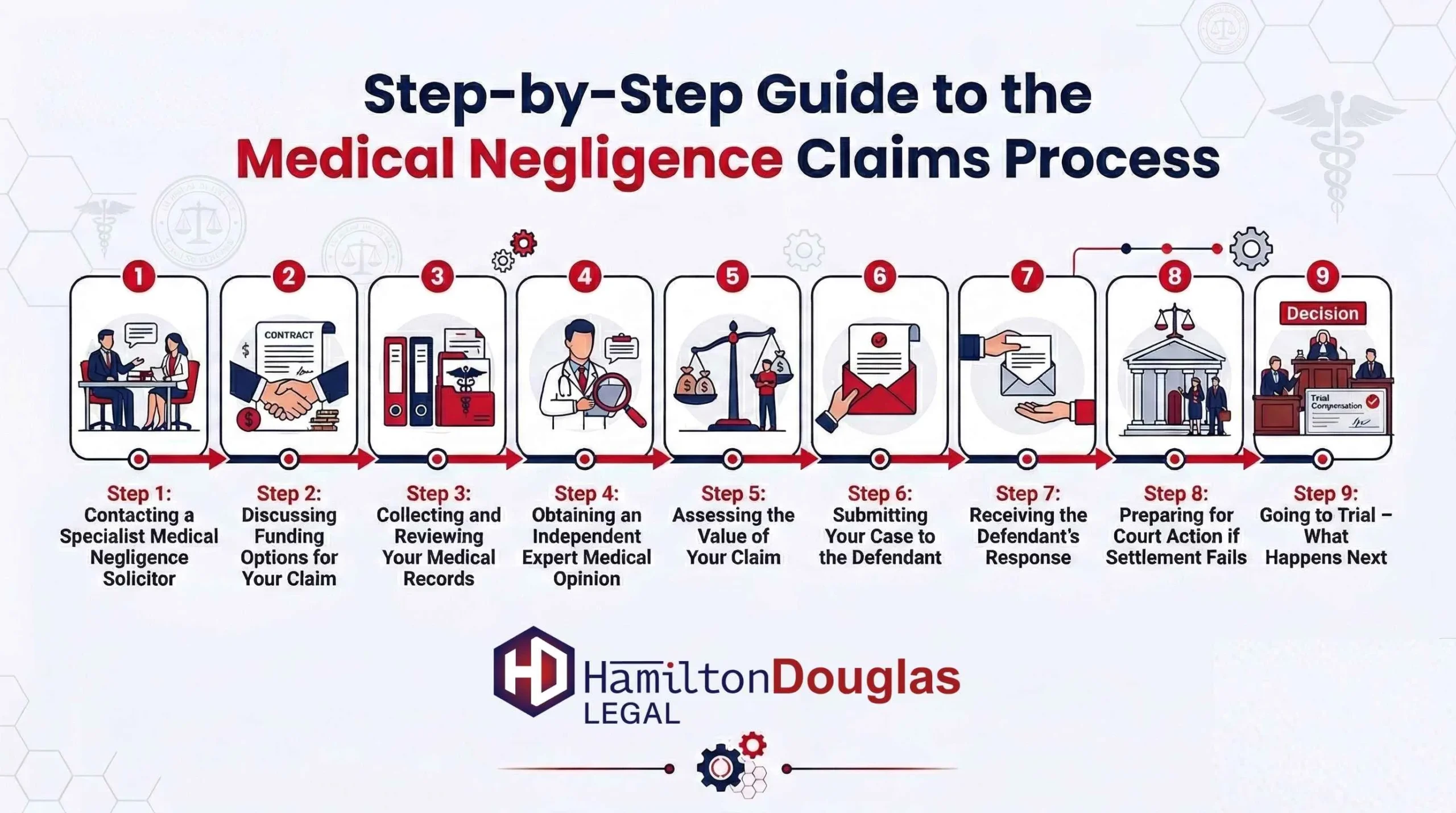
Step-by-Step Guide to Medical Negligence Claims Process:
In Scotland, making a claim follows a clear path that your solicitor will guide you through. Together, you gather records, consult independent experts, and explain what went wrong and how it affected you. This forms the base for fair compensation.
Below, we explain the stages of a medical negligence claim so you know what to expect. You will see how the medical negligence claim process moves from early advice to evidence, then to negotiation or court if needed. Use it to plan your next steps.
Step 1: Contacting A Specialist Medical Negligence Solicitor
Contacting a solicitor who specialises in your field is the most important thing you can do. A skilled lawyer guides you through a complex legal process and keeps your case on track. This support matters whether your care was with NHS Scotland or a private clinic.
Choose a solicitor with real experience in medical cases. These claims often need careful evidence gathering and clear advice.
Consider these points:
- Experience with Scottish medical cases is essential, and a strong track record gives confidence.
- It is important to communicate clearly so that you always know what is going on and why.
- Reputation matters, so check reviews and ask people you trust for their opinions.
- Capacity and resources count because complex claims need time and attention.
Once you find a good fit, book an initial consultation. Bring a short timeline, any letters, and a note of your symptoms and costs. Ask the solicitor to explain what is the process of making a medical negligence claim in Scotland and what they need from you.
A good start can set the tone for the whole case. Your lawyer will go over the costs with you, get your medical records, and talk to expert witnesses about what to do next. When you have clear instructions on how to handle the legal proceedings, you can move forward with confidence.
Step 2: Discussing Funding Options For Your Claim
Funding is a key early decision. Your solicitor will explain the choices at the start and guide you through the steps in making a claim for medical negligence.
Common options include:
- No win no fee agreements, also called a conditional fee agreement. You pay nothing if the case does not succeed. If you win, most base costs are recovered from the other side, and a capped success fee is taken from your compensation.
- Legal aid: This is rare and is usually only for children with severe birth injury cases. It is means-tested and must have strong merit.
- Legal expenses insurance: Some home or other policies include cover that may fund part of a claim. Check the fine print of your policies to be sure it applies.
Think about your budget, the strength of your case, and likely costs such as expert witnesses. Your solicitor will weigh these points with you and help you choose the most suitable route.
Step 3: Collecting And Reviewing Your Medical Records
Collecting your records is a key step in how to make a medical negligence claim. Your lawyer will ask each provider for copies of your medical records so that everything is clear.
Follow these steps:
- Identify all places and people who treated you, including GP, hospital, dentist, and any private clinic.
- Send a Subject Access Request to each provider asking for your full records for the dates that matter.
- Include your name, date of birth, address, and, if applicable, your CHI number, as well as the types of records you require, such as notes, test results, and scans.
- Provide proof of identity if asked and keep copies of everything you send.
- Expect a reply within one calendar month, which can be extended in complex cases.
Once the records arrive, your solicitor will review them for signs of missed diagnosis, wrong treatment, or problems with consent. They will build a clear timeline and check that the entries match your account.
Step 4: Getting An Independent Expert Medical Opinion
Your solicitor will request that an independent medical expert investigate the accident and provide an opinion. The expert looks at the care to see if it was up to a reasonable standard and if any mistakes led to your injury. This unbiased view helps the court and both sides understand the medical issues.
The expert is carefully chosen based on their medical speciality and must not have been involved in your care. Your records and test results are sent to them so they can review the facts in detail. They may also conduct a medical examination on you if this is needed to assess your current condition.
The findings are set out in expert reports that explain breach of duty and causation in plain terms. They may also cover your prognosis, future care needs, and how your condition affects daily life and work. These opinions help value the claim fairly.
The expert might not support your case, and that is normal. If the report is not favourable, your lawyer will explain how it affects your claim and discuss your options. You can then decide whether to gather additional evidence, seek a second opinion, or pause the claim.
Step 5: Assessing The Value Of Your Medical Negligence Claim
After your solicitor has received all the evidence, they will assess your claim according to the harm that was caused and its impact on your everyday life. It is important to calculate a fair sum that reflects financial loss as well as injury.
General damages compensate for your pain, suffering and decreased quality of life. This can be both physical and psychological harm, or an inconvenience like not being able to enjoy hobbies, your job, or social events as you used to.
Special damages compensate you for your financial losses. This may include treatment and rehabilitation costs, medical travel expenses, loss of earnings, and care or home adjustments. Your solicitor will request proof, such as receipts, pay slips, and invoices.
The value of a claim is determined by the severity of your injuries, the length of recovery, and the impact of the negligence on your long-term well-being. Your age and future requirements are also considered.
You will receive an estimated compensation range once the evidence is ready. That range guides negotiation and can support a court claim if needed. In order for you to understand the big picture, your lawyer will also talk about legal costs, including what you can recover from the opposing party if you win.
Step 6: Submitting Your Case To The Defendant
Once the evidence is ready, your solicitor will send the case to the opposing party. They will draft a letter of claim that explains what went wrong, how you were harmed, and how much compensation you are seeking. It is important to make sure the medical provider and their insurer are aware of the allegations as well as the evidence you rely on.
This letter serves as a formal notification that you intend to pursue your claim and invites the other party to investigate. They should reply to the letter within 14 days and confirm they are investigating the case.
After the acknowledgement, the defender begins their review and gathers their own evidence. Your solicitor will keep you updated and may ask for any extra information that will help. This step sets up fair discussions about liability and value.
Step 7: Receiving The Defendant’s Response – Admission Or Denial Of Fault
After your letter of claim is sent, the defender has up to four months to investigate and reply. Their legal team will review your records, speak to their clinicians, and may get opinions from relevant experts.
If they admit fault in full or in part, your solicitor will start settlement negotiations. The aim is to agree on fair compensation based on the medical evidence and your documented financial losses. Your solicitor will explain each offer and determine whether it is reasonable.
If the defender denies fault, your solicitor will carefully review their reasons and the evidence they provide. They may collect more records, ask another independent expert for an updated opinion, or narrow down which issues are in dispute. If there is still no agreement, your solicitor will make a claim in court to seek a fair settlement.
Sometimes a defender makes an offer without admitting fault. Your solicitor will weigh the offer against the anticipated value of the claim and your chances of success. You will make your next decision based on clear risk and timing advice.
Step 8: Preparing For Court Action If Settlement Fails
If a settlement is not reached, your case may need to go to court. Most medical negligence claims still resolve without a trial. Even after court papers are submitted, many cases settle before a hearing.
Your solicitor will start proceedings in the appropriate Scottish court. They will submit documents that explain what happened, the harm you have suffered, and the compensation you seek. This protects your position and keeps to the legal time limits.
The papers are then served on the defender. The defender has a set time to submit a defence, and the court will begin to manage the timetable. You will be told what happens next and when.
A trial requires extensive preparation. Your solicitor may collect additional documents, arrange for updated expert opinions, and obtain witness statements.
Throughout the court action, your solicitor will explain each step and the choices open to you. They will keep negotiating if there is a chance of a fair settlement.
Step 9: Going To Trial – What Happens Next
If your case reaches trial, your solicitor will have an experienced advocate to present your case in court. They will prepare you for the day and explain the order of events. You will know where to go and what to bring.
At the trial, each side presents its case. The court hears opening statements, witness evidence, and expert testimony. Both sides then make closing submissions.
The judge decides whether the defender is legally responsible. If liability is proven, the judge looks at the medical evidence and your documented financial losses to set the level of compensation. The decision may be given on the day or issued in writing later.
If either side believes the decision is wrong in law, they may ask to appeal within strict time limits. Your solicitor will explain the prospects of success and the possible costs. Appeal steps are separate and can take time.
Trials can feel demanding, and the outcome is never certain. Strong preparation and clear evidence increase your chances of achieving a fair outcome. Your legal team will assist you at all stages and work tirelessly to achieve the best possible outcome.
DEDICATED CLAIMS ADVISORS
Our dedicated claims advisors are always available to offer free legal advice.
100% NO WIN NO FEE CLAIMS
All our claims are processed on a No Win No Fee basis; you pay nothing if you lose.

MILLIONS SECURED IN DAMAGES
To date, we have secured millions in damages.
THOUSANDS OF SATISFIED CLIENTS
To date, we have helped thousands of clients recover compensation and continue to do so.
What Can You Claim Compensation For?
You can claim for pain, suffering, and loss of quality of life caused by negligence. This covers both physical and psychological effects and how they limit your day-to-day activities at home, work, and in the community.
You can also claim your financial losses. These may include the cost of past and future treatment, rehabilitation, care and assistance, travel to appointments, equipment, and loss of past or future earnings. Your solicitor will help you gather proof so each item is valued properly. In Scotland, there is a medical negligence claims time limit; if you wait too long, your right to claim can be affected.
How To Gather Evidence To Support Your Case
Strong evidence is key to a clear, persuasive case in Scotland. Begin gathering it early and storing it in one place. Use a simple folder or spreadsheet to list what you have and what you still need.
Begin with your medical records from every medical provider involved, including your GP and any hospital within NHS Scotland, as well as private clinics. Ask for copies using a Subject Access Request and include your details and your CHI number. Keep appointment letters, referral notes, test results, and discharge summaries.
Write a short timeline in plain language. Note dates, symptoms, diagnoses, and what each clinician told you. Add photos where helpful, such as images of injuries, scars, or aids you now use.
Collect financial proof of loss. Save receipts for treatment, medication, travel, and equipment. Keep payslips, employer letters, or self-employment records that show time off work and lost income.
Ask family, friends, or carers to write short statements about what they saw and how your daily life changed. Keep a symptom diary that records pain levels, sleep issues, and limits on normal daily tasks. These daily notes make the impact easier to understand.
Your solicitor will look through everything you have and help you write a clear statement in your own words. They will look for any missing records and consult independent experts to determine what went wrong and whether negligent treatment really caused your injury. With this complete set of documents, your legal team can assess the strength of your claim and suggest the best next steps.
The Role Of Your Solicitor In The Claims Process
A specialist medical negligence solicitor gives you a real advantage in a medical negligence case. These claims are complex and depend on fine detail. A lawyer who does this type of work on a daily basis understands how to find and present the key facts.
Your solicitor will first assess whether or not you have a strong case. They listen to your story, check the time limits, and clearly explain your options. You will always know what the next step is and why it is significant. Independent medical experts to look at breach of duty and causation. If more evidence is needed, they will explain what it is and how to get it.
Once the evidence is in place, your solicitor values the claim. They look at pain and suffering as well as financial loss and future needs. You will see how the figures are calculated and what could change them.
Your solicitor writes and sends the letter of claim to the defender or their insurer. They handle all responses, track down updates, and keep negotiations moving forward. If an offer is made, they will explain the advantages and disadvantages so that you can make an informed decision.
If a settlement is not reached, your solicitor prepares the case for court. They collaborate with expert witnesses, plan statements, and meet deadlines. You will be guided through the hearing process and supported at every stage.
Costs are explained at the beginning and then revisited as the case progresses. Many firms like ours offer no-win, no-fee arrangements. Clear funding advice allows you to concentrate on your recovery while your solicitor handles the legal aspects.
Most importantly, a good solicitor will be your consistent point of contact. They protect your rights, reduce stress, and aim to secure a fair and timely result. With expert assistance, you can move through the process with confidence.
How Negotiations And Settlements Work In Medical Negligence Cases
Most medical negligence cases in Scotland are settled through negotiation rather than a trial. Settlement saves time, money, and stress for all parties. These discussions are led by your solicitor, who keeps you informed at every stage.
Negotiation starts once there is enough medical and financial evidence. Your lawyer will look at the injury, how it affects your daily life, and how much money you lost to figure out the value of your claim. Then, they will send proposals and respond to offers in writing or in person.
The goal is to put you as close as possible to the position you would have been in without the negligence. Compensation can cover treatment, rehabilitation, and care needs. It can also compensate for lost earnings and future earning capacity.
You still have the power to say yes or no to an offer. Your lawyer will tell you how each offer stacks up against the likely value of the claim and the risks of going forward. If the defender admits fault, negotiations often move faster, but a fair result is still based on evidence.
Even if court papers are submitted, most claims still settle before a hearing. Your solicitor will continue to negotiate while preparing the case in case a trial becomes necessary. This balanced approach applies pressure to the defender while defending your position.
How Long Does A Medical Negligence Claim Take?
The time it takes to make a medical negligence claim in Scotland varies depending on the circumstances. Complex treatment, multiple clinicians, and disputed issues can all take time. Clear records and prompt responses typically help things move faster.
The first stage is to conduct an investigation and gather evidence. Collecting records, speaking with you, and obtaining expert opinions can take several months and sometimes up to a year. Your solicitor will keep you updated as each piece arrives.
Once the case is ready, the defender receives a formal letter. They usually have up to four months to investigate and reply. Extensions can happen in complex cases.
If fault is admitted, negotiations may take a few months to a year. Settlement is based on medical evidence and proof of your financial losses. Many cases are settled here without going to court.
If court action is needed, the timetable can extend by one to two years or more. The court will set a timetable with strict deadlines for each stage, hear evidence from both sides, and assign hearing dates that can sometimes be several months away.
Keep the time limits in mind. In Scotland, the general limit is three years from the accident or from when you first knew that the negligent care caused harm. For children, the three-year period usually starts on their sixteenth birthday, and the clock may not run for a person who lacks mental capacity. Early advice from a specialist solicitor helps protect your position and help you avoid avoidable delays.
Coping With The Emotional And Psychological Impact
Making a medical negligence claim can be overwhelming. The process can be time-consuming and may bring up difficult memories. It is normal to feel anxious, depressed, or overwhelmed as the situation unfolds.
Build a small support circle you can lean on. Talk to trusted family or friends, and consider speaking with your solicitor about counselling or local support groups in Scotland. People who care about you should check in with you often to help you stay grounded and remember that you are not alone in this.
Give yourself breaks from the case when you need them. Let your solicitor handle the legal work and focus on rest, treatment, and everyday routines. Simple habits like gentle exercise, fresh air, and good sleep can make a real difference.

Can’t Work Due To Illness Or Injury?
Use our free online claim check tool and find out in minutes if you have a claim.
Expert Tips To Strengthen Your Medical Negligence Claim
Select a Scottish solicitor with extensive experience in medical negligence. Ask about recent results, how they use experts, and how they will keep you informed. Clear advice from the start can save time and prevent weak claims.
Do your part by gathering strong evidence early on. Request complete medical records, maintain a simple timeline of events, and keep receipts, pay slips, and travel notes. Take photos of visible injuries and keep a short symptom diary to demonstrate the day-to-day impact.
Continue to engage and ask questions. Agree on a plan for expert opinions and deadlines, and respond promptly to requests from your solicitor. Look after your health so you can concentrate on important decisions. With the right team and proper preparation, your claim has the best chance of success.
Speak To A Medical Negligence Solicitor Today
Ready to take the next step? Speak with our panel of medical negligence solicitors for clear, practical advice and a free initial conversation.
To contact us, call 01412801112 or email contact@hdclaims.co.uk. We will listen, explain your options, and outline the best way forward so you can move ahead with confidence.
Easy Ways To Get In Touch
We are here to help. Give us a call, request a call back or use our free claim check tool to get in touch with our friendly legal team. With local knowledge and a national network of experts, we have the experience you can count on.