



- Obligation-Free Consultation
- No Win, No Fee
- Award-Winning Lawyers
As Featured In:






















Check Out Our Awesome Reviews Below:
EXCELLENTTrustindex verifies that the original source of the review is Google. My insurance company recommended a firm that charged 30% and had poor reviews. I went with Hamilton Douglas instead, who charged far less and were completely transparent. They were professional, communicative, and secured me an excellent settlement. Do your research and pick them.Posted onTrustindex verifies that the original source of the review is Google. Very good service and excellent legal advice provided by HD Claims. Their team or personal injury lawyers were so understanding and accomodating, and managed to settle my injury claim in a timely manner.Posted onTrustindex verifies that the original source of the review is Google. I want to thanks the entire team, the results were as expected, very prompt and explicit in absolutely all the details provided, I recommend and I will definitely call again in the future,thanks again and i recommend you with all my heartPosted onTrustindex verifies that the original source of the review is Google. HD Claims are the real deal. Their car accident lawyers took my case seriously and got me a great result after my crash. They made the whole process easy and kept me informed every step of the way. Don't hesitate – if you need help after an accident, choose HD Claims. You won't regret it!Posted onTrustindex verifies that the original source of the review is Google. Sorted my car accident claim out super fast!Posted onTrustindex verifies that the original source of the review is Google. I got best service from them, Adnan Bhai helped me a lotPosted onTrustindex verifies that the original source of the review is Google. Friendly and professional service. I would definitely recommend to family and friends. Thank you so much, Adnan!Posted onTrustindex verifies that the original source of the review is Google. Excellent service without a doubt! 5 stars Adnan, have made a difficult time a lot easier with his outstanding support and his communication and desire for the 100% trusted and would not hesitate to recommend you to anyone should they need you.Thank you so much!Posted onTrustindex verifies that the original source of the review is Google. Process handled quickly and professionally. Kept up to date with all handlings of case. Honestly cannot recommend them enough. Thank you.Verified by TrustindexTrustindex verified badge is the Universal Symbol of Trust. Only the greatest companies can get the verified badge who has a review score above 4.5, based on customer reviews over the past 12 months. Read more
Housing Disrepair Claims: If you’re dealing with housing disrepair issues, our panel of legal experts can help you claim the compensation you deserve quickly and effectively.
Make a Claim Against Your Landlord for Disrepair Issues:
If your rented house in Scotland is falling apart and your landlord isn’t taking action to fix it, you don’t have to suffer in silence. Damp walls, broken heating, defective electrics, and leaks can make living difficult, and it is your landlord’s legal obligation to keep your home safe and comfortable.
If your landlord ignores the problem after you notify them, you have the right under Scottish housing regulations to demand repairs and even seek compensation. Taking action may feel intimidating, but with the right help, you can get the repairs done and get what you’re entitled to. Let us help you take the first step.
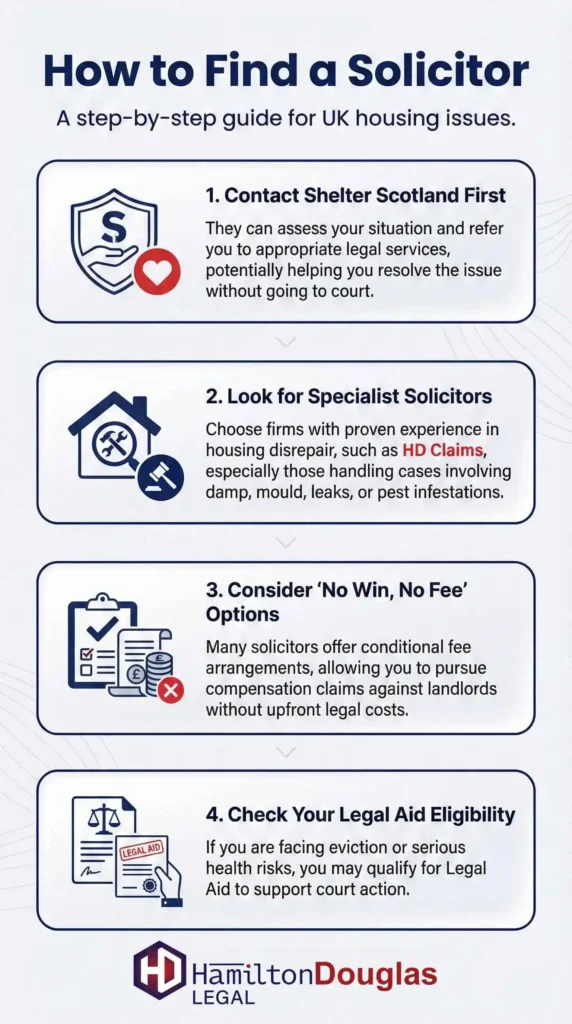
How to Make a Disrepair Compensation Claim?
If your rented house is in disrepair and your landlord has not done the repairs you requested, you can make a claim for disrepair compensation. It can seem daunting, but by following the process, you can get your landlord to sort it out and get the repairs and compensation you deserve.
Report the problem to your landlord:
Firstly, tell your landlord. You can do this in writing, via email, or by letter. Make sure you describe the situation fully and, if possible, include photos. This creates a record that shows you gave them the chance to fix the issue.
Give them time to respond:
After you’ve reported the problem, give your landlord a reasonable amount of time to do the repairs. What’s “reasonable” will depend on the severity of the problem; for example, a broken heating system in winter should be fixed ASAP.
Collect Evidence:
If your landlord ignores the problem or delays repairs, start gathering evidence to support your claim. This may include:
- Photos or videos of the deterioration
- Copies of emails, letters or messages to your landlord
- Medical documents, if the problem has affected your health
- Receipts for any costs you’ve had to pay, for example, for repairing broken items.
Speak with a solicitor:
To make the claim, get legal advice from a solicitor who specialises in Scottish house disrepair. Our panel of construction accident lawyers can guide you through the process, explain your rights and deal with the legal side of things.
Follow the Pre-action Protocol:
Before you start legal action, you have to go through a formal process called the Pre-Action Protocol. This means writing your landlord a detailed letter explaining the deterioration, known as a Letter of Claim, and giving them time to respond (usually 20 working days).
Take Legal Action:
If your landlord doesn’t respond or won’t fix the issue, your solicitor can help you go to court. The court can order your landlord to do the repairs and may award you compensation for any distress, damage or health problems caused by the disrepair.
By doing this, you can get your voice heard and get the repairs and compensation you’re entitled to under Scottish law. If you’re not sure where to start, talking to a solicitor will make it a lot simpler.
What Are Housing Disrepair Claims?
Housing deterioration occurs when a rental property is not adequately maintained and becomes dangerous, unhealthy, or unfit to live in. This could include issues like dampness, mildew, broken heating, defective electricals, leaks, and structural problems. In Scotland, landlords have a legal obligation to keep their properties in good condition and meet basic living standards.
If your landlord doesn’t fix these issues after you’ve reported them, you may be able to make a housing disrepair claim against private landlord. This allows you to take legal action to ensure that the repairs are done and to seek compensation for any inconvenience, property damage, or health issues caused by the deterioration. The process includes gathering proof, contacting your landlord, and, if necessary, taking the case to court. Claims for housing deterioration can help keep landlords accountable and ensure that tenants live in safe, livable houses.
What Can You Include in Housing Disrepair Claims?
1. Claim for Property Damage in Housing Disrepair Cases
If your belongings have been destroyed as a result of problems in your rented house, you may be allowed to include them in your housing disrepair claim. Property damage can occur for a variety of reasons, including leaks that ruin carpets or furniture, moisture and mould that destroy clothing or bedding, and defective electrical systems that damage appliances.
Landlords in Scotland are required to keep their properties in excellent condition by law. If they fail to address problems after you’ve informed them about them, resulting in damage to your personal belongings, you can seek compensation. To support your claim, you’ll need to provide evidence such as pictures of the damage, invoices for any products you’ve had to replace, or records of repair requests.
A claim for property damage can help you recover your damages while also ensuring that your landlord takes measures to prevent future problems.
2. Personal Injury Compensation in Housing Disrepair Claims
If you or someone in your family was injured or became ill as a result of poor living conditions in your rented house, you may be eligible to receive personal injury compensation. In Scotland, landlords have a legal responsibility to keep their premises safe and free of risks. When major problems are not addressed, they can result in injuries, such as slips and falls caused by poor flooring or staircases, as well as diseases, such as respiratory disorders caused by dampness and mould.
To make a claim, you must provide documentation linking the disrepair to your health issues or injuries. This might include medical records, images of the problem, and proof that you have notified your landlord about the problem. Compensation might cover the expense of medical care, missed wages, or simply the general pain and stress caused by living in dangerous conditions.
3. General Inconvenience Claims for Housing Disrepair
Living in a house with unresolved maintenance concerns can have a negative impact on your everyday life in several ways. Whether you can’t use a room because it’s damp, don’t have hot water, or are constantly dealing with leaks, these issues may make your home seem anything but pleasant. In Scotland, if your landlord fails to address such concerns within a reasonable period after being notified, you may be able to include general inconvenience in your housing disrepair case.
This type of claim focuses on how the deterioration has impacted your capacity to live properly at home. It is not just about the physical harm but also the inconvenience, stress, and discomfort produced by the situation. For example, if you’ve been unable to use your kitchen for weeks or if mould has made your bedroom unlivable, you may be able to seek compensation for the inconvenience.
Speak to our compensation experts
It doesn't cost you anything to know where you stand.
Fill out the form, and we'll get back to you within one hour.
Need to speak to us sooner?
Call us on 0141 280 1112
- Over £3+ Million in Settlements
- No Win, No Fee
- Supporting Scots Since 2010
- 10 Offices Around Scotland
Request a FREE call
How Much Compensation For Housing Disrepair?
The amount of compensation for housing disrepair in Scotland depends on how it’s affected you. The severity of the issue, how long it lasted and how it’s affected your health, belongings or quality of life.
Compensation will cover things like damage to personal items (e.g. mouldy furniture), health problems caused by the disrepair and general inconvenience (e.g. not being able to use certain rooms).
There’s no set amount, but claims can result in compensation of hundreds or thousands of pounds, depending on the circumstances. Talking to a solicitor will help you work out how much you’re entitled to.
Am I Eligible to Make a Disrepair Claim?
In Scotland, you may be able to make a housing disrepair claim if your landlord fails to correct concerns in your leased house after you report them. To qualify, the disrepair must:
- Be something your landlord is responsible for, such as dampness, mould, faulty heating, or broken electrics.
- Have been notified to your landlord, providing them a fair amount of time to resolve the situation.
- Have caused harm, such as property damage, health issues, or disruptions in your everyday life.
The Housing (Scotland) Act 2001 and the Housing (Scotland) Act 2006 compel landlords in Scotland to ensure that their houses are safe and fit for human habitation. If they fail to fulfil this obligation, you have the right to take action.
Claims can be made during your tenancy or up to five years after the issue was first reported. A solicitor can assist you in determining if you are qualified and walk you through the procedure.
Contact Us Right Away on 0141 2801112.
How Long Does It Take to Settle a Housing Disrepair Claim?
The time it takes to settle a housing disrepair claim in Scotland varies for each case. Many claims are settled within a few months, especially if the landlord agrees to make repairs and pay quickly. However, if the matter gets to court or requires further proof, it might take up to a year. Working with a solicitor can help speed up the process and guarantee that everything is done correctly.
Time Limits for Housing Disrepair Claim?
Under the Prescription and Limitation (Scotland) Act 1973, you have up to 5 years to make a housing disrepair claim for violations of your landlord’s duty to maintain the home. This time begins on the day the breach occurs, which is when you first report the problem to your landlord, and they fail to resolve it.
The limitation period for personal injury claims in Scotland arising from disrepair (for example, health issues caused by moisture or mould) is three years from the date of the accident or sickness. It is critical to act quickly to ensure that your claim is made within the appropriate deadline.
Making A Personal Injury Claim In Scotland
Our panel of experienced personal injury lawyers excel in handling cases against well-funded insurance companies.
Our specialised injury lawyers will assist you with your claim, keep you informed throughout the whole process, and provide you with legal advice that is easy to understand.
01
Get In Touch.
Tell us your story, we're here to listen and provide you with an initial assessment based on your circumstances.
02
We’ll Prepare Your Claim.
We'll be by your side to take care of the legal process. We'll keep you informed of every step of the way.
03
Receive Compensation.
If your claim is successful, we'll ensure that you get your compensation as soon as possible.

"A Student’s Journey from Trauma to Triumph: Efthymios’s Fight for Justice After a Devastating Car Accident"
When Efthymios was injured in a car accident, he was left with severe facial injuries. He didn’t know how he would manage his recovery and studies.
“When I got in contact with HD Legal, they made me feel supported. They were incredibly understanding and fought hard for me, ensuring I received the compensation I deserved.”

"Cracked Pavement, Broken Ankle: How HD Legal Helped Margaret Find Justice and Peace of Mind"
When Margaret tripped on a neglected crack in the pavement in Glasgow, she shattered her ankle and was forced to take months off work, unsure how she would manage.
“HD Legal were a lifeline for me. They took care of everything—from gathering crucial evidence to battling the council—and gave me the peace of mind I needed to focus on my recovery.”

"Blown Away: HD Legal Fights for Douglas After Faulty Washing Machine Explosion"
When Douglas’s new washing machine exploded, it caused a fire that damaged his kitchen and left him with painful burns.
“HD Legal fought relentlessly for me when it seemed like no one else would. They were thorough, professional, and supported me every step of the way, helping me recover both physically and financially.”

"From Misdiagnosis to Recovery: How HD Legal Fought for Eilidh’s Justice and Secured the Care She Needed"
When Eilidh’s severe abdominal pain was repeatedly misdiagnosed, her condition worsened, leading to the need for urgent surgery.
“HD Legal stood by me when I felt lost. They were thorough, professional, and fought tirelessly to get me the care and compensation I needed to heal.”

"Falling from Heights, Rising with Justice: How HD Legal Secured Compensation for Alistair After a Workplace Accident Involving Faulty Scaffolding"
Alistair Campbell’s fall from faulty scaffolding left him with serious injuries and months of recovery.
“HD Legal’s panel of solicitors fought for me, ensuring I received the support needed to move forward.”
Key Statistics on the Rising Rate of Housing Disrepair?
Housing deterioration issues are becoming more widespread, with tenant complaints increasing dramatically. Nearly 48% of renters now experience serious concerns like dampness, leaks, and malfunctioning heating systems, putting their health and safety in danger.
Compensation claims for disrepair have also climbed dramatically, with payouts expected to reach £3.7 million by late 2023, more than three times the previous year’s total. In Scotland, social landlords are already held responsible under the Housing (Scotland) Act 2001 and the Scottish Housing Regulator, which regulates tenant rights and landlord duties.
For renters in Scotland, the message is clear: if your landlord fails to satisfy their legal obligations to maintain your property, you have the right to take action. House disrepair is more than an inconvenience; it is a significant problem that must not be overlooked.
DEDICATED CLAIMS ADVISORS
Our dedicated claims advisors are always available to offer free legal advice.
100% NO WIN NO FEE CLAIMS
All our claims are processed on a No Win No Fee basis; you pay nothing if you lose.

MILLIONS SECURED IN DAMAGES
To date, we have secured millions in damages.
THOUSANDS OF SATISFIED CLIENTS
To date, we have helped thousands of clients recover compensation and continue to do so.
Types of Housing Issues No Win No Fee Solicitors Can Help With
No Win No Fee Housing Solicitors can help you if your property in disrepair is giving you trouble. When your home is damp, your heating system breaks, or the electricity doesn’t work right, it can be unsafe or uncomfortable to live there. You don’t have to bear the burden alone; these solicitors work on a no-win, no-fee basis, which means you won’t pay unless your claim is successful.
Another common problem is structural damage, such as a leaking roof or unstable floors. Without professional assistance, these issues can be dangerous and difficult to resolve. A no-win-no-fee housing solicitor will ensure that your landlord accepts responsibility and completes the repairs.
Mold is another issue that can cause serious health problems, including respiratory problems. A solicitor can assist you in obtaining compensation for any personal injury caused by your landlord’s failure to address the issue. You can regain the safety and comfort of your home with the right legal assistance.
How to Start Your Claim with a No Win No Fee Housing Solicitor
Starting your claim with no win no fee solicitors for housing is simple and straightforward. First, contact us and explain the problems you’re having in your rented property, whether they’re damp, broken heating, or something else. Our experienced solicitors will assess your case and walk you through the entire process.
If your landlord does not act after you report the problem, our panel of no win no fee housing disrepair solicitors can take over. We’ll gather the evidence you need, such as photos, emails, or medical records, and work on your behalf to get your landlord to resolve the issues. You will not have to worry about upfront costs with our no-win, no-fee agreement.
If you’re ready to take action and make a claim, call us right away at 0141 2801112 and we’ll put you in touch with one of our no win no fee housing disrepair solicitors.
FAQs
What Issues Are Eligible For A Housing Disrepair Claim against Landlord?
You can claim for issues like dampness, mould, faulty electrics, broken heating, leaks, pest infestations or structural problems that make your home unsafe or uninhabitable. The issue must be your landlord’s responsibility, and you must have reported it to them and given them a reasonable time to fix it.
Can I Withhold Rent During A Housing Disrepair Claim?
Withholding rent is generally not recommended in Scotland, even if your landlord is not resolving the problem, because it may result in eviction for rent arrears. However, in certain circumstances, you may be entitled to a rent reduction if the disrepair makes the property uninhabitable. Always seek legal advice before taking any action regarding rent to make sure you follow the right procedure and protect your rights.
Can I Claim Housing Disrepair Compensation If I Rent Privately?
Yes, even if you rent privately in Scotland, as long as the issue is your landlord’s responsibility and they haven’t acted after you’ve reported it. Under Scottish law, private landlords are required to keep homes safe and habitable.
What Should I Do If My Landlord Refuses To Make Repairs?
If your landlord won’t make repairs, start by keeping a record of all correspondence, emails, letters and messages; collect evidence of the damage, photos or videos. You can then report the problem to your local council’s Environmental Health department or seek legal redress through the First-tier Tribunal for Scotland Housing and Property Chamber. A solicitor can help you through this procedure.
How Much Compensation Can I Receive For A Housing Disrepair Claim?
The amount of compensation is determined by the severity of the deterioration, how long it lasted, and how it affected you. Compensation might cover property damage, medical expenses, and general inconvenience. The payouts might range from hundreds to thousands of pounds, depending on the case.
What Are The Funding Options For Housing Disrepair Claims?
Many solicitors in Scotland offer No Win, No Fee agreements for housing disrepair cases. This means you will not pay anything upfront and will only pay a fee if your housing disrepair claim is successful. This makes it easier for renters to obtain legal assistance without incurring financial costs.
We’re Here To Help When You Need Us Most.
Call us on 0141 2801112, or leave us a message below to request a call back and one of our team will be in touch as soon as we can.